About
What is Kitabu AI? Every question parents ask, answered
Kitabu AI is a personal tutor app for Kenyan learners, built by Jambo AI Studio in Nairobi. It follows the CBC syllabus strand by strand, teaches in English and Kiswahili, and costs KSh 250 a month per learner after a free diagnostic. Parents see progress every week.
The short answer
Kitabu AI is a personal tutor app for Kenyan learners. It sits in a phone, follows the CBC syllabus strand by strand, and explains schoolwork patiently in English or Kiswahili until it makes sense — then gives the learner practice to prove the idea landed. It was built by Jambo AI Studio, a Nairobi company, and it costs KSh 250 a month per learner after a free diagnostic. Every week, the parent gets a plain-language summary of how the learning is going.
That is the whole idea in three sentences. The rest of this page answers the specific questions parents ask before they trust an app with their child’s learning — what it does, what it costs, who built it, whether it’s safe, and what it is not.
What Kitabu AI does for the learner
Think of the 8 PM homework moment: the worksheet is confusing, the teacher’s explanation has faded, and nobody at home remembers how CBC wants the answer shown. That is the gap Kitabu fills. The learner asks the question and gets it explained step by step, the CBC way. If it doesn’t click, they ask again — and again — with no classmate watching and no teacher to feel embarrassed in front of. Patience is the point: a child can ask the same thing five times without shame.
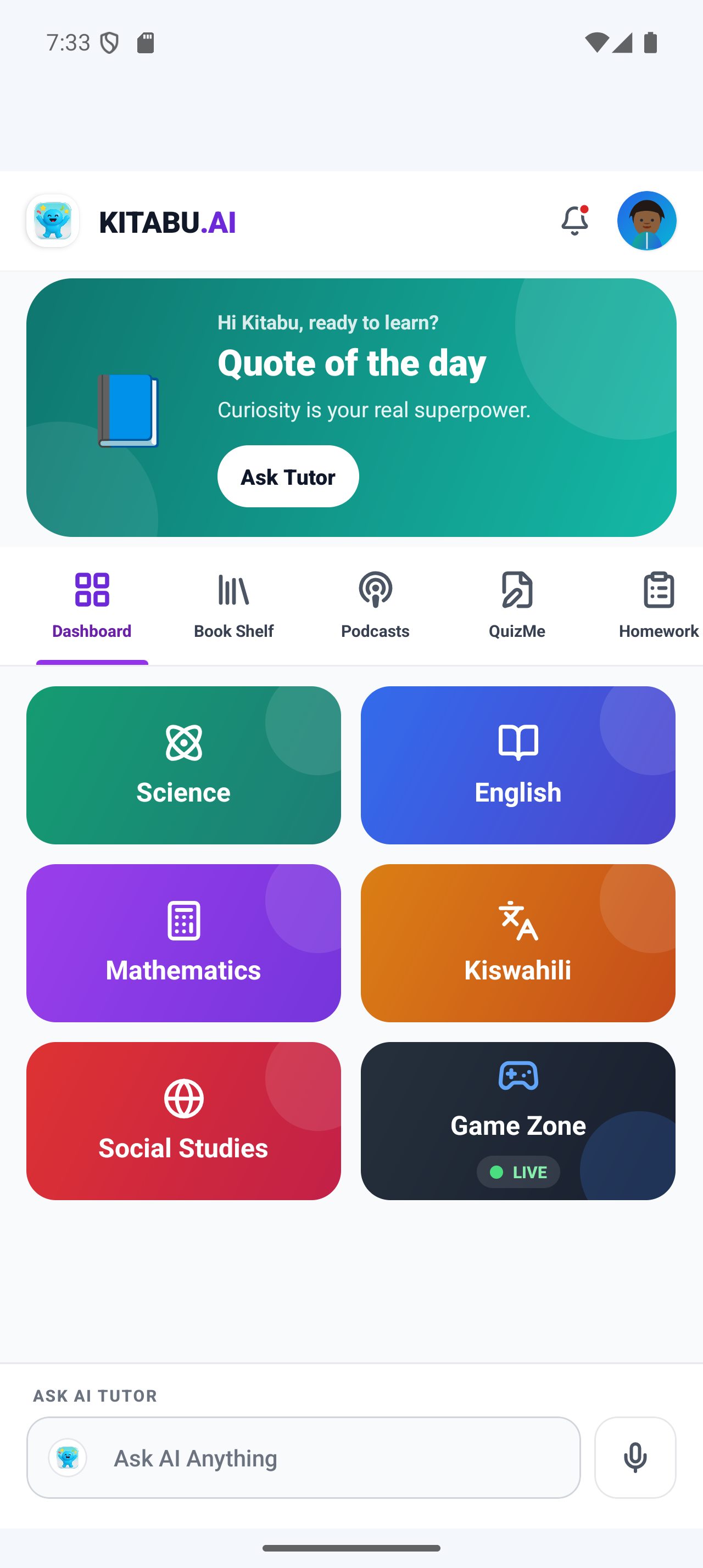
The app teaches in both English and Kiswahili, so a learner can get the explanation in the language the idea makes sense in. And after every explanation comes practice — a short quiz or set of questions — because understanding you can’t use is understanding that fades by morning. There are lessons, practice, quizzes, leaderboards and streaks to keep a child coming back, so revision feels less like punishment and more like a game they’re trying to win.
Crucially, all of this follows the CBC syllabus strand by strand. That phrase matters more than it sounds. A generic study tool might teach fractions "a" way; Kitabu teaches them the way your child’s teacher expects the working to be shown and the way the assessment rewards. The home explanation and the classroom explanation line up, instead of quietly competing and leaving the child stuck between two methods. The curriculum designs it follows are the ones published by the Kenya Institute of Curriculum Development, and the national checkpoints it prepares for — KPSEA in Grade 6, KJSEA in Grade 9 — are set by KNEC.
What parents see
Most learning apps ask a parent to take the child’s word for it. Kitabu is built so you don’t have to. There is a daily dashboard where you can see what your child studied, how long they focused, which topics improved, and where they’re still stuck. You don’t need to be good with technology or read complicated charts — it’s plain language.
That daily view is deliberately simple: activity, understanding, weak topics, next steps — enough to answer the question every parent quietly carries, "is my child actually learning, or just holding the phone?" It separates time spent from real progress, because a child can spend an hour on a screen without much to show for it. Kitabu shows you the difference.
Then, every Friday, one message lands on your WhatsApp. Something like: "Mary struggled with decimals this week but improved from 42% to 68%." That single line does more than a term of guessing. It tells you where to point your energy while there’s still time to act — long before a report card would. If you want the fuller picture of what that visibility feels like, our guide to being a parent who can actually tell if a child is revising walks through it.
What a week with Kitabu AI looks like
To make it concrete, picture an ordinary school week. On Monday your child hits a wall with decimals during homework and asks the tutor to explain it again — twice, in Kiswahili the second time — then answers a short practice set. On Wednesday you glance at the dashboard and notice decimals still shows as shaky, so you nudge them toward one more lesson. By Thursday the practice scores are climbing. On Friday, a WhatsApp message tells you the week’s honest story in one line. Nobody had a two-hour standoff, nobody had to become a CBC expert, and the gap got smaller before it could grow. That rhythm — small, visible, repeated — is the whole design.
What Kitabu AI costs
The lead price is KSh 250 per month, per learner — less than the price of one revision book, and a fraction of a single tuition session. Before you pay anything, you start with a free diagnostic that takes about fifteen minutes: a friendly check-up, not a punishing test, that maps exactly which strands are solid and which are shaky. No card is needed to run it.
You pay with M-Pesa, the way Kenyan households actually pay, and only when you’ve decided the app is right for your child. Weekly and annual options exist if a monthly rhythm doesn’t suit your family. The full breakdown lives on our pricing page. The principle behind it is simple: real revision should be affordable in shillings, not priced in dollars for a Kenyan family to translate.
Who built Kitabu AI, and why
Kitabu AI is built by Jambo AI Studio, a company based in Nairobi. It was founded by Samora Kibagendi, who set out to solve a problem every Kenyan parent recognises: the methods children are taught today aren’t the methods we were taught, tuition is expensive, and by the time a report card reveals a gap, the term is over. You can read the fuller story on our founder’s page, and more about the team on the about page.
The name matters here too. Kitabu means "book" in Kiswahili — a fitting name for a study companion. Because it is such a common word, several unrelated services carry similar-sounding names, and search results can mix them up. To be clear: Kitabu AI is its own product, found at kitabu.ai, made by Jambo AI Studio for Kenyan CBC learners. If you arrived here looking for a bookshop, an e-book reader, or a fintech service, this isn’t that — this is the tutor app for schoolwork.
Is Kitabu AI safe?
Yes — and safety is designed in, not bolted on. Kitabu is a guided, age-appropriate space built for schoolwork. It is not open-ended browsing where a child can wander anywhere; every conversation is about learning, and the app steers back to the syllabus rather than off into the wider internet. Parents keep a window into what’s happening through the daily dashboard and the Friday summary, so nothing about a child’s use is hidden from the adults responsible for them. We explain the safeguards in full on our safety page.
What Kitabu AI is not
Being honest about the limits is part of being trustworthy, so here is what Kitabu is deliberately not:
- It is not a replacement for the teacher. The classroom, the syllabus and the mwalimu still do the main work. Kitabu is the patient second explanation for home — support for school, not a substitute.
- It is not an answer-dumping shortcut. It won’t finish a child’s homework for them. It explains, then makes the child practise, because a completed worksheet a child can’t explain only hides the gap until exam time.
- It is not random screen time. The games inside it are the revision. Time spent is time you can see, measured against real topics, not open-ended scrolling.
Is Kitabu AI legit?
It’s a fair question to ask of any app before handing it your child and your M-Pesa PIN, and the honest answer is straightforward. Kitabu AI is a genuine product from a named Nairobi company, Jambo AI Studio, with a named founder, Samora Kibagendi, and a real support channel — you can reach a human at hello@kitabu.ai or on WhatsApp. It has a clear price in shillings, a free diagnostic you can run before paying a cent, and no card required to try it. Legitimacy shows in exactly these details: a real company, a real price, a real way to reach someone, and nothing hidden from the parent. Anything that hides those things is what you should be wary of — not this.
How to start
Starting is meant to be low-risk on purpose. Download the app, run the free diagnostic to find your child’s real starting point, and pick one subject where they most often get stuck. Watch the first Friday summary. If it’s helping, continue for KSh 250 a month with M-Pesa; if it isn’t, you’ve paid nothing. For a wider view of how AI tutoring fits a Kenyan family — what to demand from any tutor app and what warning signs to avoid — read our complete parent’s guide to AI tutors in Kenya.
If you’d like a patient teacher on call for the 8 PM questions — and a Friday message telling you how the week really went — download Kitabu AI and start free.
Common questions
How much does Kitabu AI cost?
KSh 250 per month, per learner — less than one revision book. You start with a free ≈15-minute diagnostic, no card needed. Weekly and annual options exist too, and you pay with M-Pesa only when you choose to continue.
Is Kitabu AI legit and safe?
Yes. Kitabu AI is a real product built by Jambo AI Studio in Nairobi, founded by Samora Kibagendi. It is a guided, age-appropriate space built for schoolwork — every conversation is about learning, and parents can see what happened each week.
Which grades does Kitabu AI cover?
Grade 4 to Grade 10. The lessons follow the CBC (now CBE) syllabus strand by strand, so the tutor teaches the way the child is actually assessed at school.
Does Kitabu AI work offline?
Downloaded books and saved lessons work offline, so a child can keep revising without data. The live tutor — asking a new question and getting a fresh explanation — needs an internet connection.
How do I pay for Kitabu AI?
You pay with M-Pesa. The lead price is KSh 250 per month per learner, with weekly and annual options. You only pay after the free diagnostic, once you decide the app is right for your child.
Does Kitabu AI replace the teacher?
No. It is a patient second explanation for home — it supports the classroom, it does not replace it. The teacher still teaches, sets work, and assesses. Kitabu helps a child practise until an idea becomes clear.