Revision
How to know if your child is actually revising (not just holding the phone)
Every parent knows the scene: door closed, phone in hand, "I’m revising." Sometimes it’s true. Here’s how to tell — kindly — when it isn’t.
Why "umesoma?" doesn’t work
The nightly interrogation has a design flaw: it can only ever collect one answer. "Yes." A child who studied for two focused hours says yes; a child who watched videos for two hours says yes. The question isn’t dishonest — it’s unanswerable. Time with a book open, or a phone in hand, simply isn’t evidence of learning either way.
It also puts the child in an impossible position. Answering honestly with "not really, I got distracted" invites a scolding, so the incentive quietly runs the other way — toward a confident "yes" regardless of what actually happened behind the closed door. A better question doesn’t ask for a report on effort; it asks for evidence of it.
None of this means most Kenyan teenagers are lying to their parents most nights. Many genuinely are revising, and many are somewhere in between — starting with real intent, then drifting after ten focused minutes once the door is closed and nobody is checking. The point of everything that follows isn’t to assume the worst. It’s to replace an unanswerable question with a system that can tell the difference, kindly, for whichever situation is actually true in your house.
The signs of real revision
- They can explain it back. Real revision leaves residue. "Teach me the thing you revised" for two minutes tells you more than an hour of supervision. Confusion here isn’t failure — it’s information.
- Something gets produced. Worked examples, practice answers, quiz scores — real revision leaves artifacts. Reading without producing anything is the weakest form of study.
- The same topics don’t stay "hard" forever. If fractions are the excuse in Week 2 and still the excuse in Week 8, revision isn’t happening — avoidance is.
- Effort shows up in results, eventually. Not overnight. But real weekly revision shows a visible climb within a few weeks.
None of these signs require snooping through a phone or reading private messages. They all come from a short, respectful conversation — which is exactly why the weekly ritual below works better than daily suspicion.
The 5-minute weekly check ritual
You don’t need a nightly audit — a short Sunday-evening ritual, done consistently, tells you more than daily interrogation ever will. It takes about five minutes:
- Look at one produced artifact. Ask to see one thing from the week — a set of practice answers, notes, or a quiz score. Not everything, just one real object.
- Ask for a two-minute teach-back. "Teach me the thing you’re most sure about from this week." Listen without correcting. Confidence and clarity here are the signal.
- Ask one kind, specific question. Not "did you revise?" but something like "what was the hardest question this week?" A child who has actually revised usually has a ready answer; a child who hasn’t tends to go vague.
- Note the topic that keeps reappearing. If the same subject or topic comes up as "hardest" three Sundays running, that’s the one to act on — not with pressure, but with a plan.
What makes this ritual work is its predictability. Because it happens every Sunday, at roughly the same time, in roughly the same five minutes, it stops feeling like an ambush and starts feeling like a normal part of the week — closer to checking the shopping list than to an interrogation. Children settle into rituals faster than they settle into surprise questions, and a ritual they can anticipate is one they stop resenting.
Phone rules that don’t start a war
The phone itself isn’t the enemy, and rules built around banning it tend to collapse the first time revision genuinely needs to happen on it. A few rules tend to hold up in real Kenyan households, whether the phone is shared or personal:
- A fixed study window. Revision on the phone happens inside an agreed time block, not "whenever," so it’s easy to notice when it slides outside that window.
- Phone on the table, not in the bedroom, during study time. Visibility removes the temptation without removing the tool — you’re not reading the screen, you’re just present.
- Revision app time counts differently from scrolling time. Time spent inside a learning app that can show what was done is not the same category as open-ended browsing, and treating them identically punishes the behaviour you actually want.
- The rule applies to the house, not just the child. A house where the parent is also visibly putting the phone down at the study window has a rule everyone can respect, rather than one that singles a child out.
These rules work best when they are agreed rather than announced. A short conversation where the whole household sets the study window together — instead of a rule handed down after a bad evening — tends to survive far longer, because a child who helped choose the boundary has less reason to fight it later.
The common thread across all four is that none of them require confiscating the phone outright — a tactic that tends to produce short battles and long resentment without actually teaching a child to manage their own study time. Rules that shape when and how a phone is used tend to outlast rules that simply try to remove it.
What productive screen time looks like in data
"He was on the phone for two hours" says nothing at all — it could mean two hours of focused practice or two hours of an unrelated video. Productive screen time has a completely different shape when you can actually see it: minutes studied on a specific subject, a quiz taken with a score attached, that score moving between attempts, and a topic named in plain language ("decimals," "comprehension"). That is a picture you can act on. "Two hours on the phone" is not.
This is the gap a reporting learning app closes. Instead of asking a child to self-report an unanswerable question, the app itself produces the record: what was studied, for how long, which quiz was taken, what improved. Kitabu’s Friday WhatsApp message is built exactly for this — a line like "Mary struggled with decimals this week but improved from 42% to 68%" replaces a whole week of guessing with one sentence of fact.
Contrast the two records side by side. "Two hours on the phone" tells a parent nothing about what happened in those two hours and invites suspicion by default, because there is no way to check it. "38 minutes on decimals, one quiz attempt at 42%, a second attempt at 68%, streak day 6" tells a parent almost everything that matters, and invites trust by default, because the record either exists or it doesn’t. The second kind of record is what turns a nightly stand-off into a five-minute Sunday conversation.
Make the phone testify
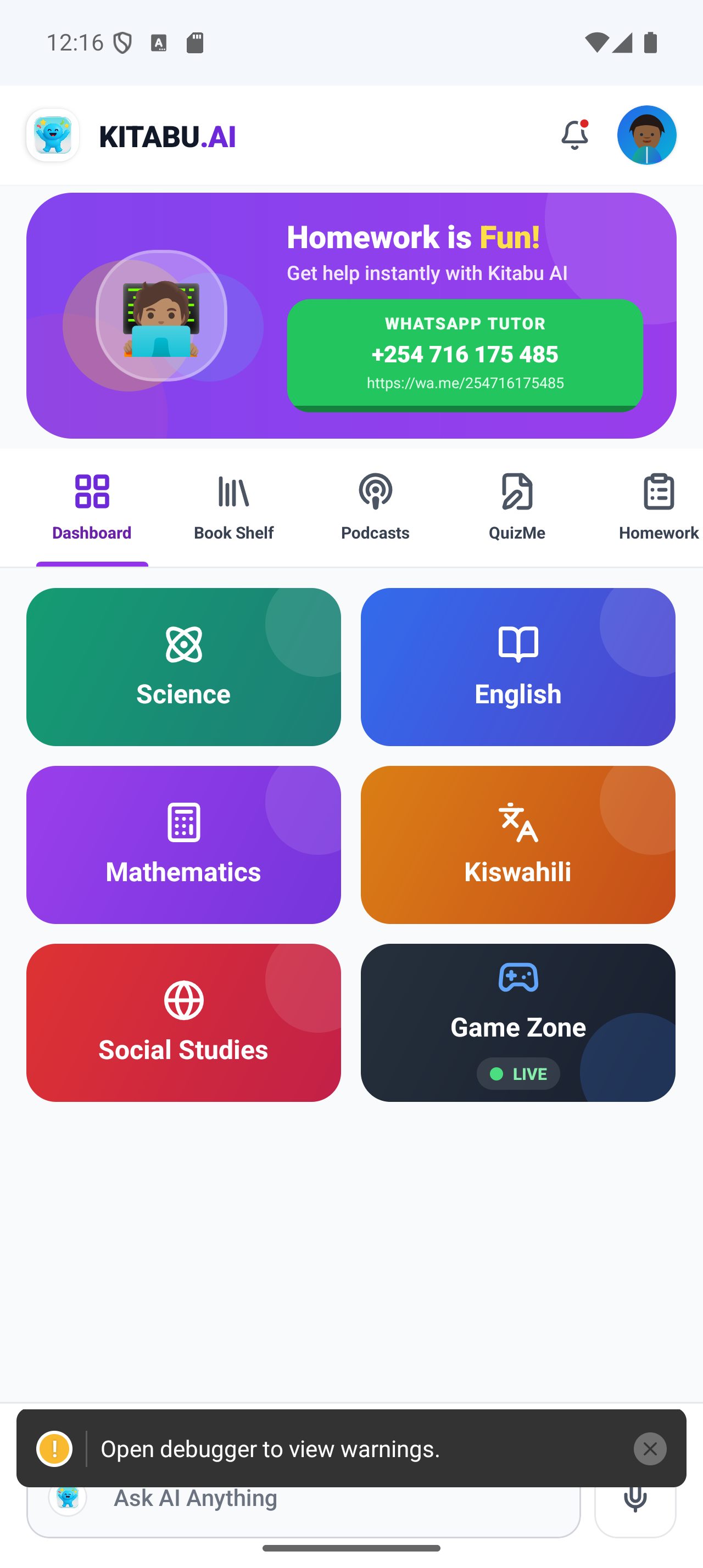
Here’s the modern problem: revision genuinely happens on phones now — and so does everything else. The fix isn’t confiscation; it’s visibility. When revision happens inside a learning app that reports honestly, the phone itself becomes your witness: what was studied, for how long, which quiz was taken, what improved. That’s exactly the window Kitabu gives parents — a daily dashboard, and every Friday a WhatsApp message like "Mary struggled with decimals this week but improved from 42% to 68%." No interrogation required. More on why that timing matters: progress updates before report cards.
Sometimes the worry is the problem
It is worth saying plainly: sometimes the child genuinely is revising, and the parent’s anxiety — not the child’s effort — is what needs attention. If the weekly ritual keeps turning up a produced artifact, a confident teach-back, and a topic that is clearly moving over several weeks, that is real evidence of real work. Trusting that evidence, rather than continuing to interrogate a child who is already doing the right thing, protects the relationship and the motivation that makes revision sustainable in the first place. Visibility should build trust in both directions — proof for the parent, and relief for a child who no longer has to defend an honest evening.
It is worth noticing, too, what happens to a household once this shift is made. A parent who has stopped needing to interrogate has more evenings that are simply calm — no door-knock, no "umesoma?", no guessing. And a child who no longer has to defend an honest evening tends to volunteer more, not less, because there is nothing left to hide and no benefit to hiding it. The goal was never certainty down to the minute; it was removing the guessing game for both of you.
Keep it kind
The goal isn’t catching a child pretending — it’s removing the pretending as an option while protecting trust. Swap "umesoma?" for "show me your best question this week." Celebrate produced work, not hours logged. Whatever the ritual turns up on a given Sunday — strong progress, a stalled topic, or a quiet admission that the week slipped — react the same calm way each time, because a predictable, kind response is what keeps a child willing to show you the truth next week too.
And if revision needs a patient teacher to become worth doing, Kitabu AI starts free — the games inside it are the revision, and you can see exactly what they did.
Common questions
How many hours should my child revise daily?
There’s no single right number, but a short, focused, daily habit beats occasional long sessions. What matters more than the hour count is whether the time produces evidence — a teach-back, a quiz score, a named topic — rather than just elapsed minutes.
How do I check my child is revising without spying?
Ask for a two-minute teach-back of what they studied, look at one artifact they produced (notes, practice answers, a quiz score), and ask one kind, specific question. None of that requires reading their messages or watching over their shoulder.
Is revising on a phone real revision?
It can be, and increasingly is. The difference isn’t the device, it’s whether the app reports honestly what was studied, for how long, and what improved. A phone that testifies with data is a completely different thing from a phone that’s just "on".
What are the signs my child is not really revising?
The clearest signs are: they can’t explain back what they "studied," nothing is ever produced (no notes, no practice, no quiz taken), and the same topic has been "hard" for weeks with no movement at all.
What should I do if I find out they’ve been pretending to revise?
Stay calm and curious rather than punitive — a child who fears the conversation will hide better next time, not revise more. Move to visible tools (an app that reports what was actually done) and a short honest check-in routine instead of relying on trust alone.